

- Soak the rice cakes and press the tofu
Place 400 g rice cakes in a bowl and cover them with 600 ml water. Let the 400 g rice cakes soak in the 600 ml water for 15 minutes so they soften slightly and cook evenly later. At the same time, wrap 400 g firm tofu in a clean towel and press it gently for 10 minutes, then cut the 400 g firm tofu into bite-size rectangles that will hold their shape in the pan.
- Mix the sauce
In a small bowl, stir together 45 ml light soy sauce, 15 ml dark soy sauce, 25 ml black vinegar, 10 ml toasted sesame oil, 12 g brown sugar, 2 g white pepper, and 120 ml water until the sugar dissolves. The mixture should smell savory, slightly sweet, and gently sharp, with a deep brown color that will turn glossy in the pan.
- Coat the tofu
Pat the 400 g firm tofu dry once more, then toss it with 30 g cornstarch until every surface has a thin, even coating. The tofu should look lightly dusty rather than clumpy, which will help it form a crisp shell instead of a gummy coating.
- Brown the tofu
Heat 25 ml neutral oil in a large skillet or wok over medium-high heat. Add the 400 g firm tofu in a single layer and cook for 8 to 10 minutes, turning several times, until the 400 g firm tofu is deeply golden on the edges and releases easily from the pan. Transfer the browned tofu to a plate once it feels firm outside but still tender in the center.
- Sear the rice cakes
Drain the 400 g rice cakes well and shake off excess water so they can color in the pan. Add 15 ml neutral oil to the same skillet over medium heat, then spread in the 400 g rice cakes and cook for 5 to 6 minutes, turning often, until they become glossy, lightly puffed in spots, and marked with pale golden patches. If a few pieces stick at first, keep moving them gently as the surface firms up.
- Cook the aromatics and cabbage
Add 20 g ginger, 18 g garlic, 50 g scallion, and 220 g green cabbage to the skillet with the rice cakes. Stir-fry over medium-high heat for 3 to 4 minutes until the 20 g ginger and 18 g garlic smell fragrant, the 50 g scallion softens, and the 220 g green cabbage wilts while still staying lightly crisp and bright green.
- Combine and glaze
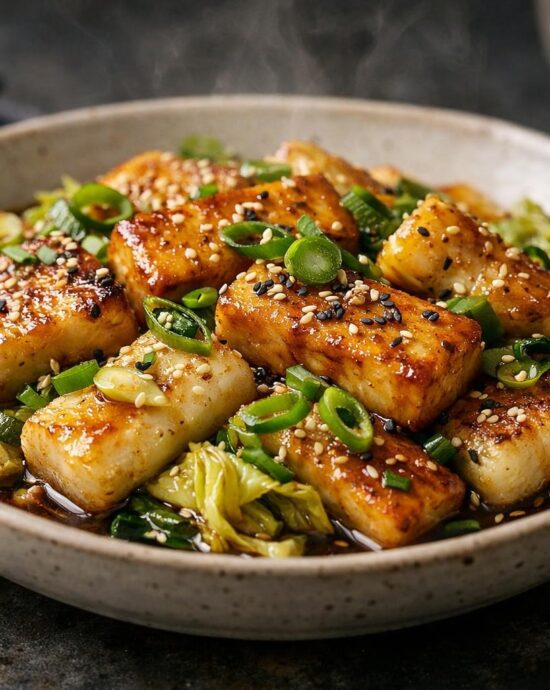
Return the browned 400 g firm tofu to the skillet and pour in the sauce made with 45 ml light soy sauce, 15 ml dark soy sauce, 25 ml black vinegar, 10 ml toasted sesame oil, 12 g brown sugar, 2 g white pepper, and 120 ml water. Toss everything for 2 to 4 minutes over medium heat until the liquid reduces into a shiny glaze that coats the 400 g rice cakes and 400 g firm tofu evenly. The pan should look saucy but not soupy, and the cabbage should be tender with lightly crisp edges.
- Finish and serve
Scatter 12 g toasted sesame seeds over the skillet and fold once or twice so the seeds cling to the sauce. Let the dish sit off the heat for 1 minute to settle, then serve while the 400 g rice cakes are still chewy and the 400 g firm tofu is hot and crisp-edged.
- Calories:468 kcal
- Protein:21 g
- Carbohydrates:47 g
- Fat:22 g
- Fiber:4 g
- Sugar:7 g
- Sodium:1080 mg
If you love the texture of stir-fried rice cakes at dim sum restaurants or Chinese home-style eateries, this recipe brings that same irresistible chew and light crispness into an approachable weeknight format. The rice cakes are pan-seared first so they develop bronzed spots and slightly crackly edges, then tossed with tofu that has been browned until deeply golden. A sauce built from soy sauce, black vinegar, sesame oil, ginger, garlic, and scallions clings to every surface, creating a dish that is savory, aromatic, and balanced without feeling heavy.
What makes this recipe especially useful for home cooks is that it relies on straightforward supermarket ingredients and a practical cooking sequence. Pressing the tofu briefly helps it brown instead of steam, while a simple cornstarch coating gives it a delicate crust that stays appealing even after it is sauced. The cabbage adds sweetness and body, the scallions keep everything bright, and the final texture lands somewhere between a stir-fry and a comfort-food skillet supper. It is substantial enough to serve as a stand-alone main dish, and it also works well for meal prep because the flavors settle in beautifully while the rice cakes remain pleasantly chewy.